WooCommerce or Shopify for a Bulgarian online store?
For most Bulgarian stores, WooCommerce is the more practical choice when Econt, Speedy, cash on delivery, local payment methods and control over SEO matter. Shopify is a better fit if you want to get started faster, sell mainly abroad and prefer a hosted platform over handling technical maintenance. The right choice depends on your catalogue, shipping, accounting and how you plan to grow the store.
 Ивелин КириловChief Technology Officer (CTO)
 Владислав БарковManaging Director

What is the practical difference between WooCommerce and Shopify?
WooCommerce is an extension for WordPress. You choose the hosting, theme, plugins and how data is stored and processed. This gives you a great deal of freedom, but you are also responsible for updates, backups, security, performance and compatibility between extensions.
Shopify is a hosted SaaS platform. Hosting, an SSL certificate, the core infrastructure and some security features are included in the subscription. You do not manage a server, but you depend on the plan you choose, the platform's rules and the apps in its ecosystem.
This is not about which platform is better in general. The question is whether you prefer control and local integrations, or a more standardised process with fewer infrastructure tasks.
Which platform is cheaper?
WooCommerce does not charge a fee for the core extension, but running a store is not free. You pay for hosting, a theme, paid plugins, development, security and maintenance. Shopify has a predictable subscription, but apps, payment fees and non-standard features can increase the total cost.
| Cost | WooCommerce | Shopify |
|---|---|---|
| Platform | The core extension is free; you pay for hosting and add-ons. | A monthly subscription based on the selected plan and payment method. |
| Hosting | You choose it separately, and it must match the store's traffic and catalogue. | Included in the subscription. |
| Theme and extensions | There are free and paid themes, as well as plugins with one-off or recurring licences. | The theme and apps may add monthly or one-off costs. |
| Payments | A payment provider fee according to your agreement. | A payment provider fee and potentially an additional fee charged by Shopify, depending on the plan. |
| Development and integrations | Professional online store: €840-€6,300. A complex catalogue, ERP integration and non-standard processes may fall outside the scope. | Professional online store: €840-€6,300. Custom apps and checkout changes increase the budget. |
| Maintenance | Updates, monitoring, backups and optimisation are required. | Less infrastructure maintenance, but the theme, apps and integrations still need attention. |
When comparing costs, make sure you are comparing the same scope. A standard store with a ready-made catalogue is not the same project as a B2B store with custom pricing, thousands of products, quote requests and warehouse synchronisation.
With WooCommerce, check the licence terms and who will update the plugins. With Shopify, check the current subscription price for Bulgaria, payment terms and app costs. A low starting price can become expensive if, after launch, the courier, payment method or warehouse requires manual work.
Which platform works better with Econt, Speedy and cash on delivery?
For a store that sells mainly in Bulgaria, WooCommerce usually has a practical advantage. It offers ready-made extensions and API integrations for Econt and Speedy, office or address selection, shipping cost calculation, waybill creation and cash on delivery.
Shopify can also be connected to a courier. Depending on the specific process, this can be done through an app, an external service or a custom API integration. Do not assume that an app called “delivery” covers your entire process.
- office pickup or delivery to an address
- price calculation based on weight and destination
- automatic waybill creation
- cash on delivery and marking orders as paid
- shipment tracking in the customer’s account
- refused shipment, address change and return
- partially fulfilled order and out-of-stock items
The same applies to card payments. Check the specific payment provider, 3D Secure, refunds, euro payments and how the data reaches accounting. The availability and terms of Shopify Payments for Bulgaria must be confirmed at the time of launch.
Which platform is better for SEO in Bulgarian?
Both WooCommerce and Shopify can rank well in Google. The result depends on the categories, product pages, speed, internal linking, content and technical settings. The platform cannot compensate for unclear descriptions or a poor catalogue structure.
WooCommerce gives you greater control over URLs, meta data, schema markup, canonical URLs, filters and landing pages. This is useful for a complex catalogue and for working in Bulgarian and English. That freedom also allows for mistakes: duplicate filters, indexed tags and many thin pages.
Shopify offers a more standardised foundation. It is harder to damage part of the technical structure during normal operation, but you have less control when it comes to special SEO requirements. When migrating to or from Shopify, you need to plan 301 redirects because the old URLs may already be generating organic traffic.
If SEO is an important sales channel, define the categories, filters, title templates and indexing rules before uploading the products. If you need a technical audit and structure, see the SEO optimisation service.
When is WooCommerce a better fit?
- You mainly sell in Bulgaria and rely on Econt, Speedy, cash on delivery and a local payment provider.
- You have specific rules for prices, discounts, product variants or customer groups.
- You want control over hosting, data, content and the SEO structure.
- You plan to connect to inventory software, an ERP, a CRM or custom order logic.
- You already use WordPress and have a person or partner who will maintain the system.
WooCommerce is not a choice without technical upkeep. If the theme and plugins are selected hastily, you may end up with a slow website, conflicting extensions and difficult maintenance. Define in advance who will monitor updates, backups, security and the response to payment or order problems.
When is Shopify a better fit?
- You want to validate an idea quickly and the catalogue is relatively standard.
- You sell in several countries and accept the limitations of a SaaS platform.
- You do not have a technical team and prefer a predictable monthly cost.
- Your team will manage products, orders and promotions without working on the server.
- You are ready to check the couriers, payments, apps and tax reporting in advance.
Shopify does not eliminate all technical tasks. Problems can arise with apps, translations, inventory synchronisation, advertising pixels, cookie consent and non-standard promotions. The more apps you add, the more closely you need to monitor dependencies, total cost and possible conflicts.
How can you choose a platform without making an expensive mistake?
- 01Describe the real order process
Write down how the customer selects a product, delivery method and payment method. Add a refused shipment, return, exchange, partial stock availability and an invoice for a company. This way, you will compare a real process rather than just the platform’s homepage.
- 02Make a list of integrations
Check Econt, Speedy, the payment provider, accounting, the warehouse, the ERP or CRM system and advertising channels. For each connection, clarify who sends the data, who receives it and what happens in the event of an error. For a complex process, see how API integrations between systems work.
- 03Prepare a test catalogue
Choose products with variants, different VAT rates, promotions, dimensions, weight and limited stock. Add a product that requires a quote request if this is part of your business.
- 04Calculate the total cost
Include the subscription, hosting, licences, apps, payment fees, maintenance, migration and integrations. Compare the same scope, not just the price of the core platform. For the development itself, the guide price for an online store is €840-€6,300; the specific scope determines where it falls within the range.
- 05Plan for ownership and exit
With WooCommerce, clarify access to the code, hosting and database. With Shopify, check how you will export products, customers, orders and content if you ever change platforms. This does not mean migration is impossible, but it does mean it needs to be planned.
What does the choice look like for a real Bulgarian store?
For a standard store with products in stock, courier delivery and card or cash-on-delivery payments, we would start with WooCommerce. It gives you more freedom for local processes and SEO growth, without depending on the availability of a specific app.
For an international store with a standard catalogue, Shopify can reduce the infrastructure workload. This makes sense if apps, payments and delivery services are available in every country where you sell, and the fees are included in your overall calculation.
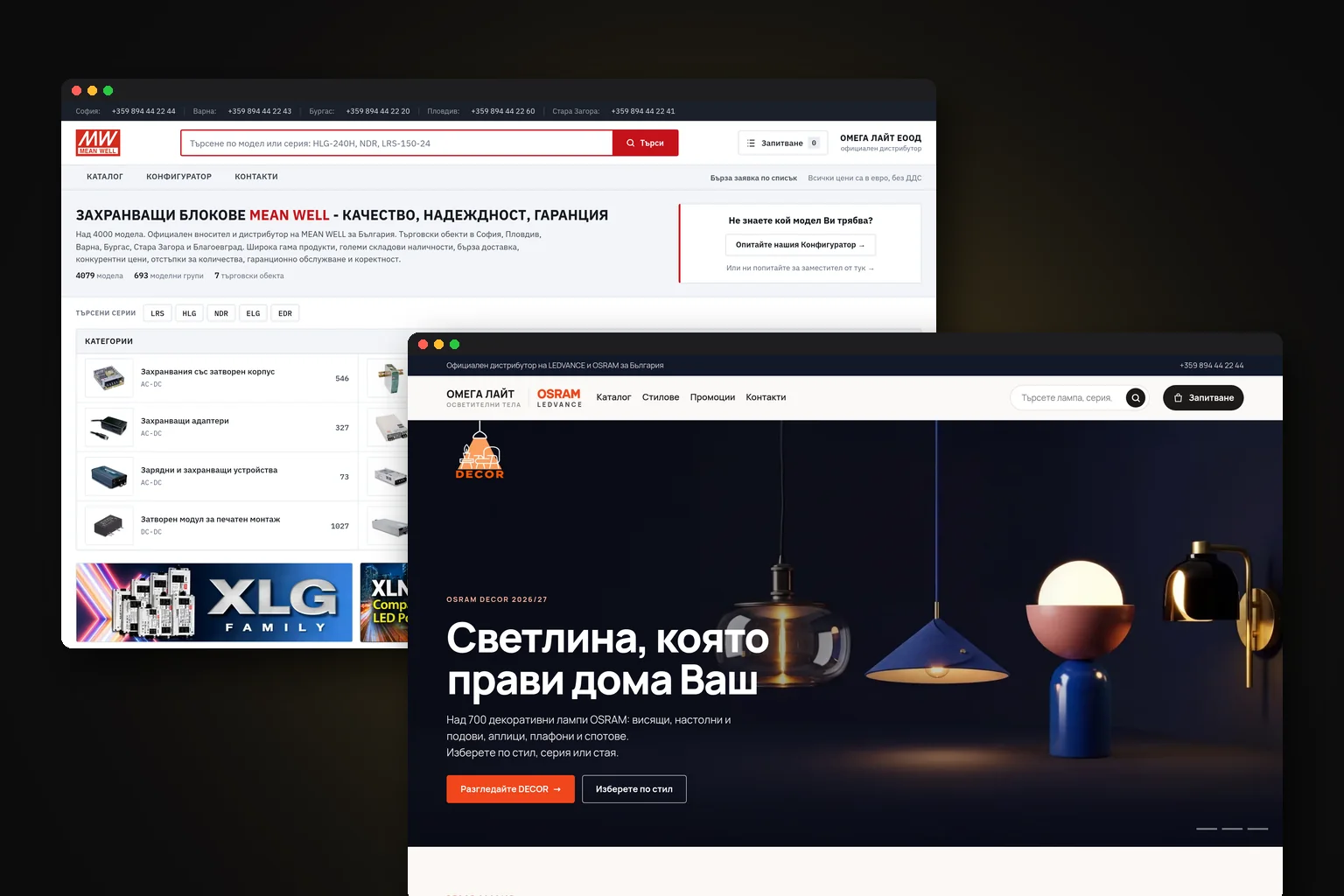
For B2B sales, a large catalogue or complex inventory, do not choose by default. Sometimes the store is just the face of the system, while the warehouse, quotations, invoices and customer-specific prices need to be managed in an ERP. Labimex is an example of a B2B e-commerce platform where the catalogue and quotation process are part of the complete solution.
For product categories with many variants and specialised search requirements, it is important to test the catalogue, not just the design. Q-Parts.bg showcases this type of project, with search by VIN number, make and model filters, and Econt integration.
Frequently asked questions
Which is cheaper: WooCommerce or Shopify?
WooCommerce has no fee for the core plugin, but there are costs for hosting, licences, development and maintenance. Shopify has a more predictable subscription, but apps and payment fees can increase the total cost.
Can Shopify work with Econt and Speedy?
Yes, but the approach depends on the available app, external service or custom API integration. Before launch, check office selection, cash on delivery, waybills, tracking and returns processing.
Which platform is better for SEO in Bulgarian?
Both can rank well. WooCommerce gives you broader control over the technical SEO structure, while Shopify is more standardised and less likely to break with a basic configuration.
Can I switch from Shopify to WooCommerce later?
Yes. Products, customers, orders and content can be transferred, but migration requires data mapping, new URLs, 301 redirects and another check of payments and courier services. Make a plan before you start, not after problems appear.
Frequently asked questions
- Which is cheaper: WooCommerce or Shopify?
- WooCommerce has no fee for the core plugin, but there are costs for hosting, licences, development and maintenance. Shopify has a more predictable subscription, but apps and payment fees can increase the total cost.
- Can Shopify work with Econt and Speedy?
- Yes, but the approach depends on the available app, external service or custom API integration. Check office selection, cash on delivery, waybills, tracking and returns in advance.
- Which platform is better for SEO in Bulgarian?
- Both can rank well. WooCommerce gives you broader control over the technical SEO structure, while Shopify is more standardised and less likely to break with a basic configuration.
- Can I switch from Shopify to WooCommerce later?
- Yes. Products, customers, orders and content can be transferred, but data mapping, 301 redirects and another check of payments and courier services are required. Migration should be planned in advance.