Pharmacy software
Custom pharmacy software is a programme for the warehouse and till of a pharmacy or pharmacy chain: every pack is recorded with its batch and expiry date, sales are made with a scanner, stock is tracked by location, and the manager gets reports. It costs 3 000-29 300 €, most often around 8 600 € (based on 98 of our quotes as of 14 August 2026), and we launch the first working version in 5 to 8 weeks. We do not have a separate pharmacy solution or a pharmacy client so far; our closest live system is the warehouse system, while we demonstrate batches and expiry dates in the food manufacturing solution.
 Ивелин КириловChief Technology Officer (CTO)
 Владислав БарковManaging Director
What it includes
- Batches and expiry dates
Each package is entered with its batch, expiry date and purchase price.
- Expiry-based stock issuing
At sale, the package with the nearest expiry date is selected first.
- Barcode scanning
Receiving, sales and stocktaking with a scanner.
- Several pharmacies
Stock and cash register by location, with transfers between pharmacies handled as a single document.
- Card payments
By card through MyPOS or in cash; we check the cash register model by model.
- Reports
Expiring batches, low stock, sales by location and by cashier.
How the process works
- 1Deliveries are received with a scanner: every package with its batch, expiry date and purchase price.
- 2When a sale is made, the system issues the package with the nearest expiry date.
- 3The manager can see stock by pharmacy and expiring batches from their phone.
Solution
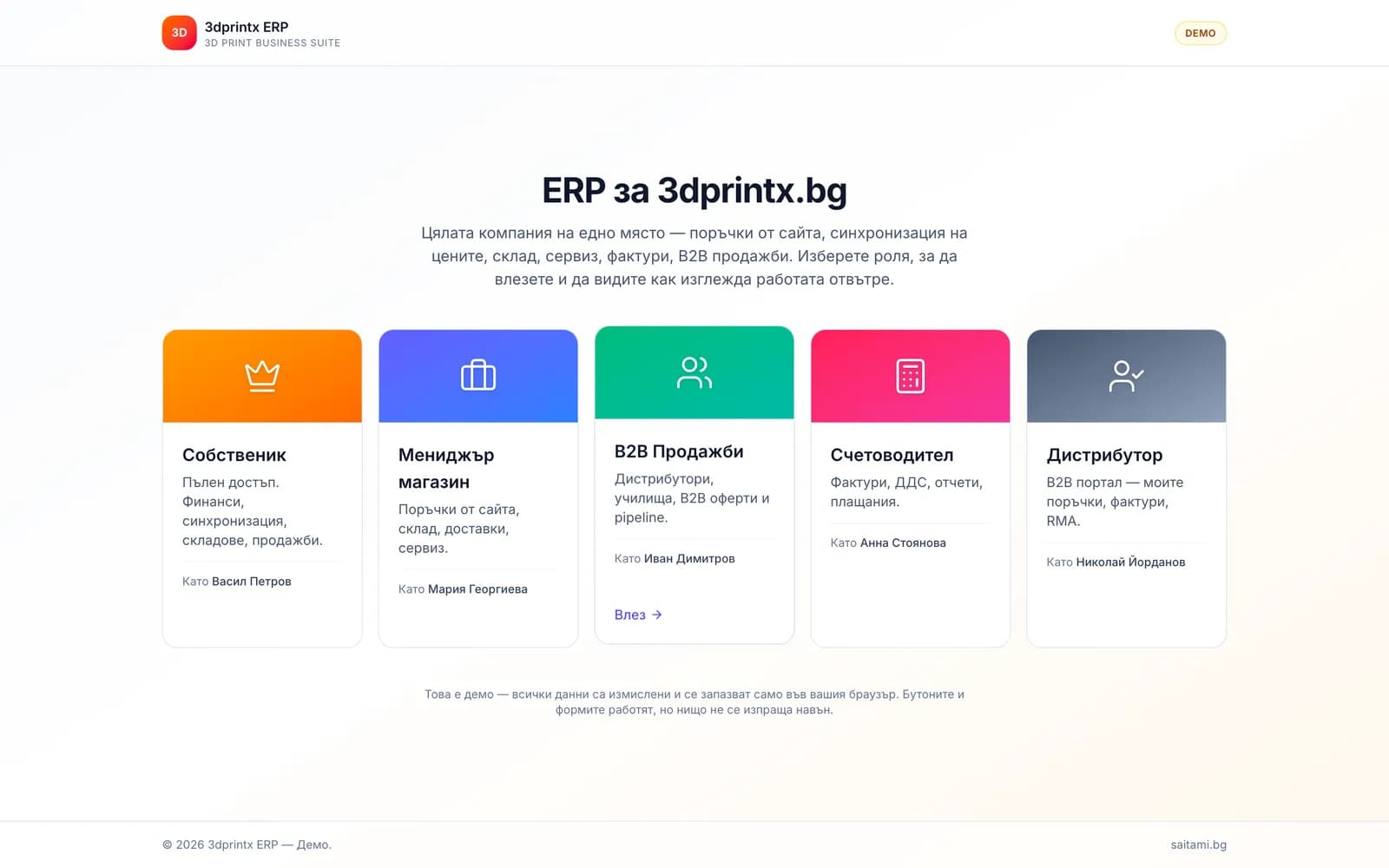
3D printers and consumables
Two-way pricing between the website and the system, online orders, inventory with shipment tracking, serial number-based servicing, and business-to-business sales.
We do not have a separate pharmacy solution. Our closest live system is the warehouse system: warehouse management, barcodes, sales and online orders in one programme. Batches with expiry dates work in the same way in the Testen Dom solution for food manufacturing.
Price
€3,000-€29,300
most often around €8,600
Based on 98 of our quotes as of 14 August 2026
Who it is for and who it is not for
Off-the-shelf pharmacy programs cover the checkout of an independent pharmacy: medicines are received from the distributor, sold at the checkout and reported to the NRA and the NHIF. Saitami handles what comes next: a chain with shared inventory, an online store, orders between locations and owner reports.
Custom pharmacy software makes sense when a ready-made program holds you back: a chain of several pharmacies with shared stock and separate checkouts, products prepared in-house, an online store that needs to draw from the same inventory, or a manager who wants to see all locations from their phone. That is also what the enquiry we received this year from a pharmacy chain looked like: stockrooms, checkouts, human resources and management reports in one system.
We build the system around your pharmacy’s process, not a template. We start with the module that is slowing you down the most-usually inventory and the checkout-and add the next ones in the same program when you need them.
What the pharmacy inventory system includes
Goods are received with a scanner. Each package is entered with its batch, expiry date and purchase price, and the delivery is recorded as a document that updates the inventory automatically. A purchase invoice from the distributor can create a new item directly from its line, just as it works in the system we built for an office equipment distributor with a central warehouse and a bookshop.
When a sale is made, the system issues the package with the nearest expiry date first. No one has to remember the dates: the software manages the issuing order. The manager can see at any time what expires during the following month and what is below the minimum stock level, by location and by batch.
A stocktake is the physical counting of the pharmacy. In the distributor’s system, it works with 2 500 items at once, is saved as a draft while counting is in progress, and distinguishes a counted zero from an item that has not been counted, so nothing is accidentally zeroed out. We bring the same logic to the pharmacy.
The reports are for the manager: sales by day, cashier and group, stock by location, expiring batches and stocktake discrepancies. Each employee sees only their own part: the cashier makes sales, the manager sees the turnover, and every action remains in the log.
The checkout and the equipment you already have
The most common question from shops and pharmacies is whether the system will work with the equipment already sitting on the counter. A barcode scanner works with any web system. For the cash register, we check the model: for a grocery shop, we specified integration with a Tremol M20 in “fiscal printer” mode in the quotation, so the receipt is printed by the device itself at the system’s command, while its registration with the NRA remains unchanged. We have not yet connected a fiscal device in a live system, so we list it as a separate line in the quotation rather than making it a promise.
We have connected card payments through MyPOS. For a POS terminal from another bank, we check the model, and the client sends it one to two weeks in advance for configuration.
Several pharmacies, one manager
The system runs in a browser, on a server that we maintain or one in your account. Nothing is installed on the computers in the pharmacy: a new computer or a new pharmacy means one more login with a password. There is no per-workstation fee: for a grocery shop with around 30 devices, this was the first question, and the answer is that you pay for the server, not for the number of people.
Each pharmacy has its own inventory and checkout, while the manager can view them all from their phone: turnover by location, low stock levels, and transfers between pharmacies using a single document, valued at the price of the location receiving the goods.
When there is an online shop, it draws from the same inventory: an order from the website enters the system as an order, and items are published from the system to the website, as with the office equipment distributor. Several pharmacies have asked us about exactly this in recent months: a catalogue and online ordering for herbal products, food supplements and cosmetics.
Prescriptions and the NHIF: what we say honestly
We have not built reporting to the NHIF or electronic prescriptions so far. If your pharmacy works with National Health Insurance Fund prescriptions, prescriptions remain in the pharmacy software, while we check the requirements, assess the integration separately and include it in the quote. We do not promise a module we have not built.
Timeline and data from the old program
First, you describe the process: how many pharmacies, what equipment, where deliveries come from and who can see what. We come back with questions and a price range, create a demo based on your process before you decide, and only then send a written quotation with an exact price and timeline.
Your current program’s data will not be lost. We transfer items, barcodes, suppliers and stock from an Excel export or from the old program’s database; batches are imported with their remaining quantities and expiry dates. We schedule the transfer for a quieter day at the pharmacy, and we are available by phone during the first few days.
We launch the first working version with inventory and checkout for one pharmacy in 5 to 8 weeks; we have quoted 35 days for inventory and checkout for a grocery shop with scales and a cash register. A system for a chain with a shared warehouse, online shop and reports by location grows afterwards, module by module. Payment is in instalments: half at the start and half on delivery. Afterwards, we maintain the program for 100-350 € per month if you wish, or hand over the code and server so you can work without a monthly fee.
Comparisons that help you decide
What you gain
Expiring stock goes out first
The system orders stock issuing by expiry date, not the person.
All pharmacies on one screen
Stock, turnover and expiring batches by location, from the manager’s phone.
No duplicate data entry
The delivery replenishes stock, the sale deducts from it, and the online order is added automatically.
How we get started
- 01
You describe the project
A few sentences about what you need are enough.
- 02
We come back with questions and a price
We ask 2-3 specific questions and tell you the price range.
- 03
We build a demo
For a website, store or software system, we build a demo made for you.
- 04
We send a proposal
A written proposal with the exact price. We meet only to discuss the solution.
Frequently asked questions
Pharmacy software: €3,000-€29,300, typically around €8,600. The exact price is included in the written proposal.
It depends on the scope, which we set out in the proposal. For comparison, here are examples from our portfolio: Pelikan DTM: since April 2026, continuously developed, Elite Call Center: 6 months, LiftexPro: 8 months.
Yours. We hand over the source code and data to you.
If you wish, we can maintain the project for €100-€350 per month. We specify what maintenance includes in the quote.
The barcode scanner works with any web system, and we have connected card payments through MyPOS. We check the cash register model by model: in a proposal for a grocery store, we specified Tremol M20 in “fiscal printer” mode, but we have not yet connected a fiscal device in a launched system, so we list it as a separate line in the proposal. We have not built prescriptions or reporting to the NHIF so far; if you need them, we check the requirements and include them in the proposal.
The counter remains on the pharmacy software with NHIF integration and e-prescriptions. Saitami's custom system is for what that software does not cover: a pharmacy chain with a shared warehouse, an online store using the same inventory, private-label products and owner reports across all locations. It costs 3 000-29 300 €.
Each package is entered on receipt with its batch, expiry date and purchase price, and at sale the system deducts the one with the nearest expiry date first. Stock is tracked by location, with transfers between pharmacies handled as a single document and stocktaking that preserves the draft while counting is in progress. We transfer the data from your current program from Excel or its database before launch.
There is no installation: the system runs in the browser on every computer and phone in the pharmacy, and a new pharmacy or computer is simply another login with a password. There is no per-seat fee. The server is with us or in your account, with daily backups; the code and data are yours.
Related software
Warehouse software
Custom warehouse software: stock by location, batches and expiry dates, barcodes, website orders, waybills and stocktaking. Price based on our quotes, delivery time, the industry solution and the Pelikan DTM system.
POS system
POS system for a shop, restaurant or service business in Bulgaria: Detelina, Microinvest, micro.bg, HelloPOS and Plus Minus, with their prices as of 17.10.2026, what Ordinance N-18 requires, and when a custom system for the warehouse, online store and reports around the till is worthwhile.
Medical clinic software
Software for a private clinic and medical centre in Bulgaria: what NZIS requires (e-prescription, e-referral, KEP), the ready-made Hipokrat, Niset and JOYSTICK programs, and when it makes sense to build your own system for bookings, payments and a patient portal alongside the medical software.
Related Services
ERP System Development
Custom ERP system development for a small or medium-sized business: inventory, sales, invoices, production and reports built around your process, with the code and data in your hands.
Online store development
An online store with a catalogue, filters, card or cash-on-delivery payments, courier shipping labels, and a connection to your warehouse or ERP system.