Taxi software
On-demand taxi software is a dispatch system for a taxi company with anywhere from ten to more than one hundred vehicles: a dispatch console with a live map of the cars and a booking queue, an Android driver app, an optional passenger app, zones and stands with allocation rules, a connection to the phone system, and reports by ride, driver and shift. It costs 3 000-29 300 €, with the taxi platforms we have quoted in the middle and upper parts of the range, based on 98 of our quotes as of 14 August 2026, with no per-ride commission and no per-vehicle licence fee, while the working platform available for review is ready within 6 weeks of the first meeting. The platform is used by Eco Taxi in Burgas and opens live without a login, with Sofia and sample cars; our first taxi company client, operating in the city and at the airport, found us after asking ChatGPT which companies build taxi software.
 Ивелин КириловChief Technology Officer (CTO)
 Владислав БарковManaging Director
What it includes
- Dispatch console
Live map with cars by status, order queue, manual order entry for phone calls, including rides without a destination.
- Zones and taxi ranks
Zones are drawn on the map with a rule for each: nearest car or queue by time of entry; taxi ranks are queues ordered by arrival time.
- Driver app
On shift and off shift, incoming order with a countdown, navigation, statuses “I’ve arrived”, “Board”, “Complete”, today’s rides and turnover.
- Passenger app
Order from the map, history or favourites, estimated price according to the tariff, car on the map and a notification when it is outside your location.
- Phone
The incoming call opens the customer and their recent addresses; book a ride with one tap.
- GPS from the phone
Each car’s location comes from the driver’s phone every few seconds, with no GPS devices and no fee.
- Reports and alerts
By ride, driver, vehicle, zone and time, with export to Excel; alerts for speeding, leaving the zone and long stops.
How the process works
- 1The booking comes in by phone, through the app or from a page with a link and enters the dispatch console queue.
- 2The system assigns it to a car according to the zone rule or to the first car at the taxi rank; if the driver declines, it goes to the next car and then to the neighbouring zone.
- 3The driver sees it in the app, moves it through the statuses, and the ride is added to the shift report.
Solution
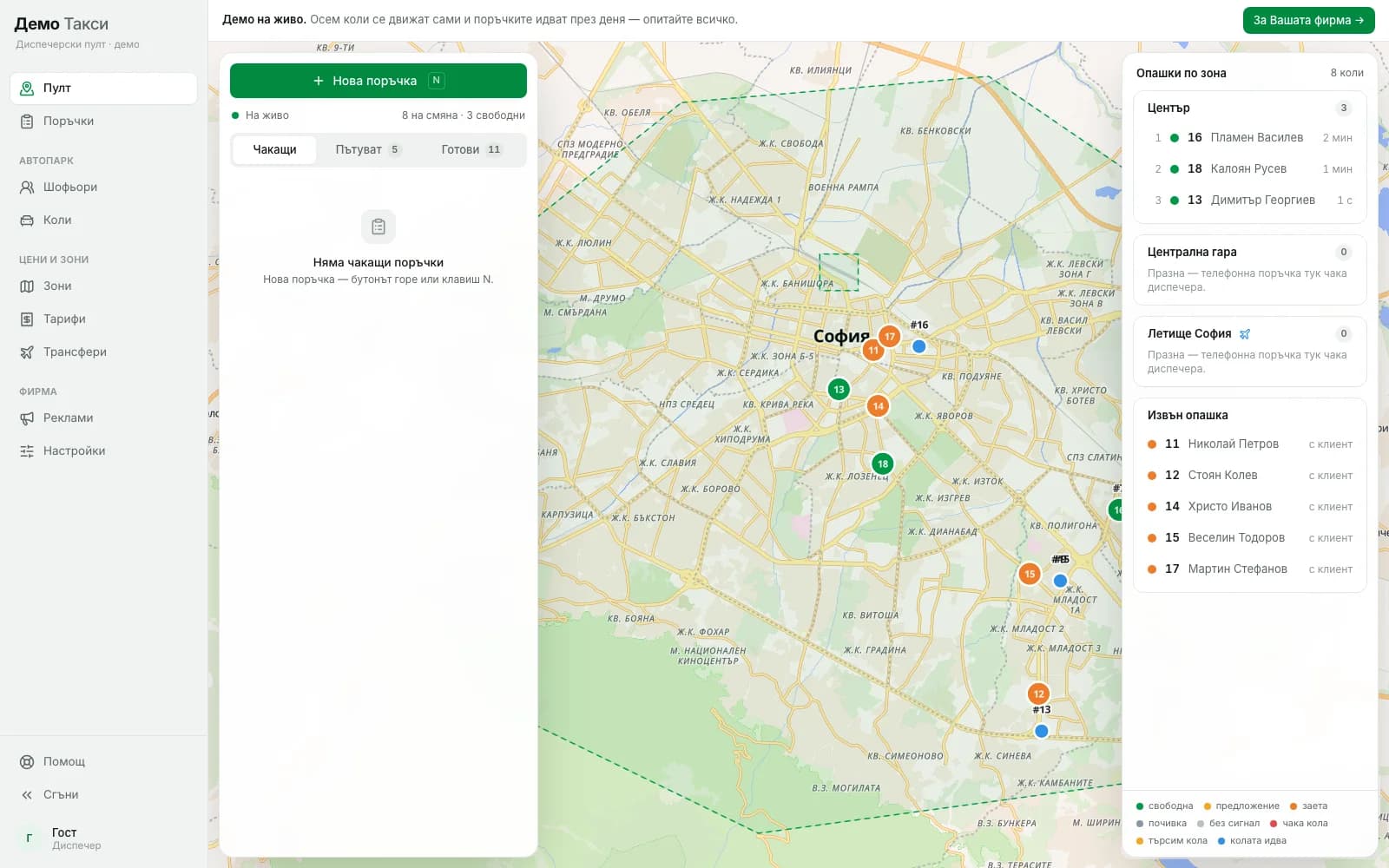
Taxi: dispatcher, driver, passenger
The Eco Taxi platform in Sofia, with eight cars moving on their own: new booking, live map, zone queues, the day's bookings, zones and fares. No login.
This is the platform used by Eco Taxi in Burgas, launched with Sofia and sample cars: it opens without a login, eight cars move on their own, bookings arrive throughout the day, and an on-screen guide at the dispatch console takes you through it step by step.
Price
€3,000-€29,300
most often around €8,600
Based on 98 of our quotes as of 14 August 2026
Who it is for
For a taxi company paying a monthly subscription for an external dispatch system and wanting its own: a one-off payment, no commission per ride, no per-car licence and no limit on the number of vehicles. The two enquiries that led us to build the platform were exactly like this: a company from Burgas with city and airport operations that wanted apps under its brand in the App Store and Google Play, and a company from Haskovo with around 70 vehicles, growing to 100, which asked us ten questions before requesting a quote: the final price for 100 cars, whether there was a monthly fee, who owned the software and data, whether there was a vehicle limit, how long it would take and how the switch could happen without interruption. The answers below are the answers we gave them.
If your company has five cars and the dispatcher is the owner with one phone, a subscription to an off-the-shelf system is cheaper, and we will tell you so. An in-house platform starts to make sense from a few dozen cars upwards, when the monthly subscription to the external system is already expensive, as the company from Haskovo told us, or when you have an airport, transfers and corporate clients that the off-the-shelf system does not cover.
The console, zones and ranks
The dispatcher sees a live map of all cars by status and a queue of bookings. When a call comes in, the system opens the customer and their recent addresses; the booking takes one tap, and a ride can also be entered without a destination. City zones are drawn on the map, each with its own rule: nearest car or queue by order of entry. Ranks are queues ordered by arrival. If a driver declines, the booking goes to the next car in the zone, then to the neighbouring zone. Dispatch is automatic, with the dispatcher able to intervene manually at any time. A declined request can trigger an automatic penalty, and the setting applies both to the dispatcher’s queue and to bookings from the app.
For an airport, there is a separate zone with a queue of cars and a board showing the day’s transfers by flight, with fixed prices by destination, flight number, number of passengers and child seats. The city operation goes live first, followed by the airport operation, because there are no flights in winter.
The driver and the passenger
The driver app runs on Android and works on existing phones and tablets, with no special hardware: on-shift and off-shift status, an incoming booking with a countdown to accept it, navigation to the customer and destination, “Arrived”, “Pick up” and “Complete” statuses, rank position, today’s rides and turnover. Real-time GPS comes from the driver’s phone every few seconds, with no GPS devices in the cars and no fee for them.
The passenger app for iOS and Android is optional, as a second offer option. Passengers book in a few taps from the map, their history or favourites, see an estimated price based on your tariff, and are charged by the in-car fiscal taximeter. They see the car on the map, the driver’s name, the make and registration number, receive a notification at around 300 metres and a “Your car is outside” message. They pay the driver in cash or, optionally, by card in the app, with the money paid into the company’s account. Bookings without the app are also possible: by phone through the console and via a link page that you place on your website or send through Viber.
The telephone system, taximeter and payments
The phone is in the dispatch console: the company's number is connected via SIP, the call is answered through the available dispatcher's headset after a short greeting, the caller's number opens the customer record and their latest addresses, the recording stays attached to the booking, and missed calls remain on a list until someone calls back. At Eco Taxi, the line is from A1 and was connected to the dispatch console in the first week; we transfer the telephony once everything is ready and approved, not on the first day. We have not connected a taxi meter so far: the fare is charged on the car's taximeter, while the passenger sees an estimated price in the app. We have connected MyPOS card payments in the taxi solution and Stripe in other systems; corporate clients with rides charged to an account and a monthly invoice are a separate module.
Switching from the current system
This is the question every company already using an external system asks: how do we switch without interruption? To get started, we do not need data from or access to the current system. The platform is built and tested with a dispatcher and two or three drivers; addresses and history are transferred at the end, and the old system is shut down once the new one has been accepted. Training is usually online, or on-site when needed. You add and remove cars and drivers yourself, in a minute, from your administrator account, without our involvement.
Timeline, price and who owns the system
We show a working platform ready for review 6 weeks after the first meeting; review in the App Store and Google Play comes after acceptance and takes from a few days to two weeks, with the accounts there in your company’s name. The city operation is accepted first, followed by the airport and corporate operations.
The taxi platforms we have quoted fall in the mid-to-upper range of 3 000-29 300 €: dispatch console, driver app, zones, reports and central dispatch as one option, with a passenger app as a second. A map of the area, corporate module and card payments are priced separately. Payment is made in instalments, with a deposit on signing and the balance on acceptance of the working platform. Hosting and support cost 100-350 € per month, if you choose them, or you can use your own server with no monthly fee payable to us. The code, data and brand are yours: no commission per ride, no per-car licence and no limit on the number of vehicles.
Projects in the industry
Eko Taxi
Taxi services
The platform is live: a dispatch console with a live map of Burgas and the phone built into it, plus the Eko Taksi app for Android and iPhone: a map of Burgas, address auto-filled from the user's location, fare calculated according to the company's rates, airport transfers from Burgas Airport at a fixed price based on the flight number, and a notification when the car is 300 m away. The platform belongs entirely to the company: a passenger app, a driver app, a dispatch console connected to the phone system, and card payments.
Taxi dispatch system
Taxi services
Dispatch panel for a taxi company: real-time orders, a GPS map of vehicles, call center, zones, drivers and alerts-all in one place.
What you gain
One map
The dispatcher sees all orders and cars without making calls.
No per-car licence
Cars can be added and removed in a minute, with no fee and no limit.
GPS without hardware
The location comes from the driver’s phone.
How we get started
- 01
You describe the project
A few sentences about what you need are enough.
- 02
We come back with questions and a price
We ask 2-3 specific questions and tell you the price range.
- 03
We build a demo
For a website, store or software system, we build a demo made for you.
- 04
We send a proposal
A written proposal with the exact price. We meet only to discuss the solution.
Frequently asked questions
Taxi software: €3,000-€29,300, typically around €8,600. The exact price is included in the written proposal.
It depends on the scope, which we set out in the proposal. For comparison, here are examples from our portfolio: Pelikan DTM: since April 2026, continuously developed, Elite Call Center: 6 months, LiftexPro: 8 months.
Yours. We hand over the source code and data to you.
If you wish, we can maintain the project for €100-€350 per month. We specify what maintenance includes in the quote.
Connections we have already built: OpenStreetMap maps, SIP telephony and MyPOS. We check other integrations and include them in the quote.
With the phone system, yes: the company's number is connected to the dispatch console via SIP, the call is answered through the available dispatcher's headset, the caller's number opens the customer record and their latest addresses, and the recording stays attached to the booking; at Eco Taxi, the line is from A1. We transfer the telephony once everything is ready. We have not connected a taxi meter so far: the fare is charged on the car's taximeter, while the passenger sees an estimated price in the app. If you need a connection to the meter, we check the model and include it in the quote.
One-off payment: the code, data and brand are yours, with no commission per ride, no per-car licence and no limit on the number of vehicles; you add cars yourself. The platforms we have quoted are in the middle and upper parts of the 3 000-29 300 € range. Hosting and support are 100-350 € per month as an option, or you can use your own server with no monthly fee to us.
To start, we do not need data from or access to the current system. The platform is tested with one dispatcher and two or three drivers for 6 weeks, addresses and history are transferred at the end, and the old system is switched off once the new one has been accepted. City rides go live first, followed by the airport and corporate customers. Training is online, or on-site if needed.
The console, driver app, zones, reports and phone system are the first version, and the company operates with them. The iOS and Android passenger app is the second version: it makes sense when your customers already order through competitors’ apps or when you have an airport and fixed-price transfers. Customers can also order without an app through a page with a link that you send via Viber.
Related software
Transport software
Transport software for carriers and freight forwarders in Bulgaria: trips, drivers, a GPS fleet map, CMR and eCMR, trip costs, tachograph and inspection deadlines. Ready-made TMS Cargo Manage and Zeron Transport with their prices as of 17.10.2026, plus when a custom system makes sense.
Fleet management software
Fleet management software for a business: vehicles on a map, drivers, trips, fuel and vehicle repairs, reminders for the technical inspection, third-party liability insurance, comprehensive insurance, vignette and tachograph. What a GPS provider supplies and what the custom-built system does.
Delivery software
Delivery management software for a company with its own drivers or a courier: routes, a driver app, a GPS map, and waybills for Econt and Speedy. Ready-made Shipday, OptimoRoute and Routific, their prices as of 17.10.2026, and when a custom system makes sense.
Related Services
ERP System Development
Custom ERP system development for a small or medium-sized business: inventory, sales, invoices, production and reports built around your process, with the code and data in your hands.
Mobile app development
Development of a mobile app for iOS and Android from a single codebase, with a server, admin panel, payments and publication in App Store and Google Play; the code and accounts are yours.