Invoicing software
Invoicing software is the software a company uses to issue invoices, proforma invoices and credit notes with all the details required under Art. 114 of the VAT Act, in euro and with sequential ten-digit numbering. For a few invoices a month, the free invoice on this page or ready-made software costing a few euro a month is enough; custom software makes sense when invoices need to be generated automatically from contracts, orders or subscriptions and customers need to pay by card. As a complete system, it costs 3 000-29 300 €, most often around 8 600 € (based on 98 of our quotes as of 14 August 2026).
 Ивелин КириловChief Technology Officer (CTO)
 Владислав БарковManaging Director
What it includes
- Invoices, proforma invoices and credit notes
With the details required under Art. 114 of the VAT Act, as a PDF and by email; an incorrect invoice is cancelled, not deleted.
- Ten-digit sequence
No gaps or duplicates, with a separate sequence for each company or site.
- Monthly contract invoices
One invoice per contract for the month, issued all at once with no duplicates.
- Quote to invoice
An accepted quote becomes an invoice with one click; the advance payment is a separate invoice.
- Card payments
The customer pays through the link via Stripe, and the card is charged automatically in the following months.
- Unpaid invoices and reminders
Paid, unpaid and overdue invoices on one screen, with reminders sent to the customer.
How the process works
- 1The quote, order or contract is entered into the system once.
- 2The invoice is generated from it, either once or every month, using the next number in the company’s numbering sequence.
- 3The customer pays by bank transfer or by card through the link, while unpaid invoices appear in the report with a reminder.
Solution
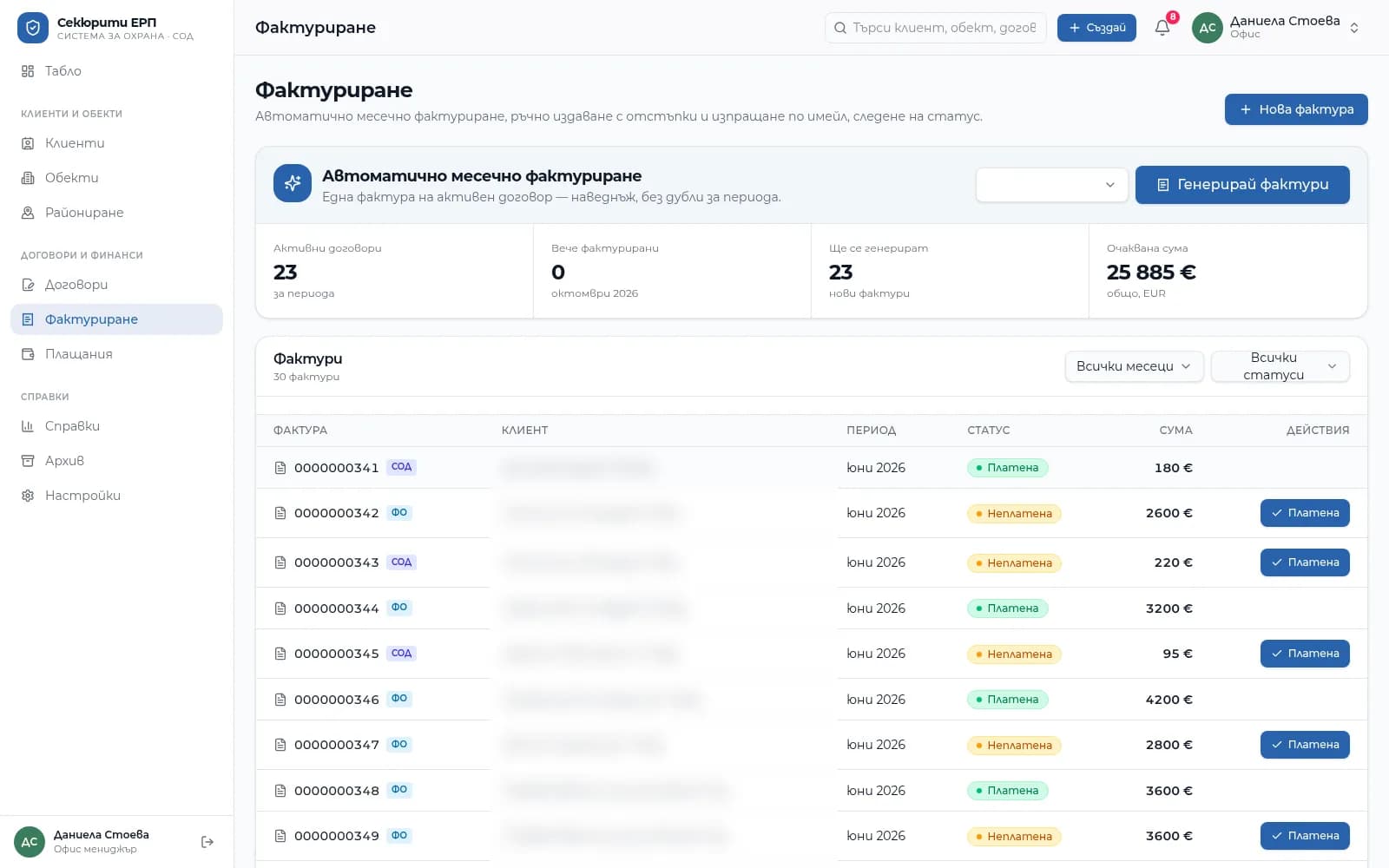
“Invoices” module in a custom-built system
Monthly invoices are generated automatically from the contracts, one invoice per contract for the month, in euros and with ten-digit numbering, while paid, unpaid and overdue invoices are all shown on one screen.
The screen is from our demo with sample data, created for a company with subscription contracts (security services). The module is the same for every industry: the contracts and services change, not the invoices.
Price
€3,000-€29,300
most often around €8,600
Based on 98 of our quotes as of 14 August 2026
Create an invoice now
Fill in the fields and save the invoice as a PDF. The required details comply with Article 114 of the VAT Act, amounts are in euros, and the amount in words is filled in automatically. Your data stays in your browser: we do not send it anywhere or store it.
Review
ФАКТУРА
INVOICE
Оригинал / Original
№ 0000000001
Дата на издаване / Date: 18.10.2026
Дата на данъчно събитие / Tax point: 18.10.2026
Доставчик / Supplier
...
Получател / Customer
...
| № | Описание / Description | Мярка | К-во / Qty | Ед. цена / Price | Стойност / Amount |
|---|---|---|---|---|---|
| 1 | ... | бр. | 1 | 0,00 | 0,00 |
| Данъчна основа / Tax base | 0,00 € |
| ДДС / VAT 20% | 0,00 € |
| Сума за плащане / Total | 0,00 € |
Словом / In words: нула евро
Плащане / Payment: По банков път / Bank transfer
Безплатна фактура от saitami.bg/programa-za-fakturi
Check details
Missing: Supplier: Company name, Supplier: Address, Supplier: UIC, Supplier: VAT number, Recipient: Company or individual’s name, Recipient: Address, Recipient: UIC or VAT number (for a company), Description
Opens the print window. Select “Save as PDF”.
Do you issue dozens of invoices a month based on contracts, orders or subscriptions? Then you need software that issues them automatically. That is what the rest of this page is about.
Which invoicing software do you need?
The answer depends on where your invoices come from, not how many there are. If you issue a few invoices manually each month, the free invoice above or the free plan of an off-the-shelf program is enough. If there are dozens of invoices coming from contracts, orders, subscriptions or inventory, the program should issue them automatically from those sources: that is a system from Saitami.
Custom software makes sense when the invoice is the final step in your process: a contract billed every month, a subscription with card payments, an online-store order, a report of minutes used or pages printed, or work performed by a field technician. In that case, ready-made software does not know where to get the amount from, and someone has to type it in. The owner of an optical shop with one location compared our quote with ready-made software costing around 200 euro per year and chose the ready-made option; for his situation, he was right.
The third option is the most common one for us: the off-the-shelf software stays with the accountant, while the custom system generates the invoices from your process and sends them to them. An entire system with invoicing as one module costs €3 000-29 300; invoicing added to a system we are already building for you is a separate line in the quote and costs less.
Off-the-shelf invoicing software: a comparison
These are the programs that small businesses in Bulgaria compare most often. The prices are taken from each program’s public pages, as read on 17 October 2026; any price we did not see there is not included in the table. Subscriptions change, so open the link before you decide.
| Program | Type | Free | Price as listed on its website | Source |
|---|---|---|---|---|
| inv.bg | cloud and app | yes: 5 customers and 5 invoices per month | 4 €, 8 € and 28 € per month, including VAT | inv.bg/plans |
| Fakturirane.bg | cloud | yes, FREE version | PRO 40 € for 6 months or 50 € for 12 months, excluding VAT | fakturirane.bg |
| Faktura1 | cloud | promotion: 200 documents for 365 days, with an advertising line | 24 €, 49 € and 184 € per year, including VAT | faktura1.com |
| fakturi.com | cloud | yes: 5 invoices per month | from 3,32 €, 5,36 € and 13,80 € per month with 24-month prepayment, including VAT | fakturi.com/packs.php |
| fakturka.bg | cloud | yes: 15 invoices per month, up to 10 customers | Pro 7,50 € and Business 15 € per month, excluding VAT; Peppol and UBL in beta | fakturka.bg/pricing |
| Rila.Tools | cloud | the first month | 6,14 € per month or 61,36 € per year, including VAT | rila.tools |
| BillBox | cloud and Android | the first month | 5,11 €, 10,23 € and 25,56 € per month, excluding VAT | billbox.bg |
| InvoicePro.bg (Microinvest) | cloud | completely free | no paid plan | invoicepro.bg |
| Microinvest Invoice Pro | Windows | completely free | no paid plan | microinvest.net |
| Plus Minus, invoicing software | Windows | free | system modules separately, for example Sales at 12 € or 20 € per month, excluding VAT | plusminus.com/bg/prices |
| Azhur, Sales module | Windows | 3-month demo | Basic 94 € excluding VAT, according to the price list dated 17.07.2025 | bsoft.bg |
| Business Navigator | Windows | no | €549 licence or €169 subscription for one workstation, excluding VAT | cfinance.bg |
| Fakturnik | Windows | one-month trial licence | 45 € for the local version or 60 € for the cloud version for one company for one year, including VAT | fakturirane.eu/pricelist |
| Stripe Invoicing | cloud, international | no monthly fee | 0.4% per paid invoice plus the card payment fee; according to Stripe, you are responsible for ensuring that the invoice meets local requirements | stripe.com/en-bg/invoicing/pricing |
| Zoho Invoice | cloud, international | yes: 2 users, 500 invoices per year | free; no Bulgarian edition | zoho.com/invoice/pricing |
| Odoo, Invoicing app | cloud | one app free | all apps: Standard 11,90 € per user per month with annual billing for the first 12 months | odoo.com/pricing |
| Custom-built software (Saitami.bg) | cloud or your own server | the free invoice on this page | full system 3 000-29 300 €, most often around 8 600 €; invoicing for a system we build is quoted separately | saitami.bg |
Sources: each program’s pricing pages, read on 17.10.2026. We do not sell or recommend any of them for payment.
What must appear on an invoice
The required details are listed in Article 114(1) of the VAT Act. An invoice must contain:
- document name: “Invoice”;
- a sequential ten-digit number containing only Arabic numerals, in one or more series;
- issue date;
- the supplier’s name and address and its identification number: VAT number, or UIC if the company is not VAT-registered;
- the recipient’s name and address and its identification number: VAT number, UIC or a VAT number from another EU member state;
- the quantity and type of goods or the type of service;
- the date of the taxable event or the date payment was received;
- the unit price excluding VAT, the taxable base and any discounts not included in the unit price;
- the VAT rate, or, in the case of a zero rate or no VAT being charged, the reason for it;
- the VAT amount;
- the amount due, when it differs from the taxable base and tax.
Signature, stamp, individuals and companies without VAT
A signature and stamp are not included in the list under Article 114(1) of the VAT Act or Article 6(1) of the Accounting Act, so an invoice without them is valid. “Prepared by” and the materially responsible person are not mandatory either; they are included because they are useful. When the taxable base and tax do not exceed €100, the invoice may omit the rate and reason, the amount due and the details of a new means of transport (Article 114(7)).
A company that is not VAT-registered may also issue an invoice, but it may not show VAT on it (Article 113(9)). It enters its UIC instead of a VAT number, and the Regulations for the VAT Act prescribe the wording “Article 113(9) of the Act” as the reason for not charging VAT. An invoice showing VAT issued by a non-registered company is subject to a fine equal to the VAT shown, but not less than 1 000 BGN, i.e. 511,29 € (Article 183).
An invoice is not mandatory for a sale to an individual who is not a trader (Article 113(3)), but one may be issued if the person requests it. In that case, the person’s name and address are entered. For a cash or card sale in a shop, an invoice does not replace the fiscal receipt: the receipt must always be issued, regardless of whether another document has been requested (Article 118(1)).
Invoices in euro from 1 January 2026
From 1 January 2026, accounting documents are prepared in euro (Article 5(1) of the Accounting Act). Invoice amounts may be in another currency, but the taxable base and VAT must be stated in euro (Article 114(5) of the VAT Act); for a foreign currency, the latest European Central Bank exchange rate as of the date the tax becomes chargeable is used.
Showing amounts in both BGN and euro on invoices is not mandatory and never has been: the Euro Adoption Act expressly excludes invoices, credit and debit notes and protocols (Article 15(3)(5)). The period of dual pricing for consumers ran from 8 August 2025 to 8 August 2026 and has now ended. The exception was an invoice issued as an extended fiscal receipt by a cash register: there, the total amount was shown in both currencies.
If you convert an amount from BGN, divide it by 1,95583 without rounding the exchange rate, then round the result to the nearest cent based on the third decimal digit (Articles 12 and 13 of the Act). A credit or debit note issued after 1 January 2026 is issued in euro, even when the invoice it relates to is in BGN from 2025: it states the number and date of the original invoice, and the amounts are converted at the applicable exchange rate.
Numbering: ten digits, no gaps, no reset
The number has ten digits, increases without duplication or gaps and does not depend on the document type, so invoices and credit or debit notes use one sequence (Article 78(2) of the Regulations for the VAT Act). Numbering does not restart at 1 January (paragraph 3). A branch or site may use its own range of numbers (paragraph 4), for example 0000000001 for the office and 1000000001 for the shop, provided the two ranges do not overlap.
When you change software, continue with the next available number in the sequence or open a new range that does not overlap with the old one. An incorrect invoice is not corrected or deleted: it is cancelled and a new one is issued, while all copies of the cancelled invoice are retained (Article 116 of the VAT Act and Article 78(5) of the Regulations for the VAT Act). That is why the systems we build have no “Delete” button for an issued document, only “Cancel”.
The sequence belongs to the company issuing the invoice, not to the software. When a new company started issuing invoices through our system, its first invoice came out numbered 0000000001, and our client asked why the invoice had a “first number”. The answer was exactly this: the new company is starting its own sequence.
Deadlines, storage and fines
An invoice must be issued within 5 days of the taxable event, or, for an advance payment, within 5 days of receiving it (Art. 113, para. 4). For a supply to a company in another EU country, the deadline is the 15th day of the following month (para. 5). A notice for a change to or cancellation of the transaction must be issued within 5 days of the change (Art. 115, para. 2). One consolidated invoice may cover several supplies made in the same month if it is issued by the last day of that month (Art. 113, para. 13).
Keep invoices for at least 10 years: the VAT Act requires 5 years after the limitation period for the obligation expires (Art. 121), while the Accounting Act requires 10 years for documents relating to tax control (Art. 12). For electronic invoices, also keep the data proving where they came from and that they have not been altered.
The fines in the VAT Act are still stated in BGN and are converted into euro at the official exchange rate. The draft amendments currently under public consultation until 23.10.2026 rewrite them directly in euro, and approximately double some of the minimum fines for companies.
| Violation | Fine today (for a company) | In euro | Under the 2027 draft |
|---|---|---|---|
| Invoice not issued, tax not charged (Art. 182, para. 1) | the tax not charged, but not less than 1 000 BGN | at least 511,29 € | at least 1 000 € |
| Same situation, but the invoice is issued in the following period (Art. 182, para. 2) | 25% of the tax, but not less than 250 BGN | at least 127,82 € | at least 250 € |
| VAT on an invoice from an unregistered company (Art. 183, para. 1) | the tax stated, but not less than 1 000 BGN | at least 511,29 € | at least 1 000 € |
| Receipt not issued (Art. 185, para. 1) | from 1 000 to 4 000 BGN | 511,29-2 045,17 € | 500-2 000 € |
| Structured e-invoice not issued (new Art. 182a) | no such obligation today | from 1 July 2028: the tax not charged, at least 1 500 € |
Sources: the VAT Act as published on lex.bg and the draft Act amending the VAT Act, consultation 12733-K on strategy.bg, accessed on 17.10.2026. The euro amounts are based on Arts. 11-13 of the Euro Adoption Act. The draft has not yet been adopted and may change.
Electronic invoices: what applies today and what is coming in 2028
Today, an invoice in PDF format sent by email is valid if it contains all the required details and the recipient accepts it. Acceptance may be implicit: the client processes or pays it (Art. 114, para. 9 of the VAT Act and Art. 78, para. 11 of the Regulations for the VAT Act). An electronic invoice is considered issued on the day it is made available in a way that allows the client to receive it (Art. 113, para. 12).
On 23 September 2026, the Ministry of Finance opened for public consultation, until 23 October 2026, a draft of amendments to the VAT Act. Under the draft, from 1 January 2028, a company registered for VAT will invoice a company, organisation or government body in Bulgaria only with a structured electronic invoice compliant with the European EN 16931 standard. The invoice will pass through an NRA system, which will assign it a unique compliance code, and will be considered issued only once the code has been generated. The recipient’s consent will not be required, and a PDF sent by email between two such companies will no longer be sufficient. The fine for failing to issue a structured invoice will apply from 1 July 2028.
Under the same draft, from 1 January 2027, the threshold for mandatory VAT registration will become 75 000 euro instead of 51 130 euro. A company that is not registered, as well as sales to individuals, will continue to use paper or PDF invoices. For supplies to companies in other EU countries, electronic invoicing and real-time reporting will become mandatory from 1 July 2030 under the European ViDA Directive (2025/516).
This is a draft, not a law: the deadlines and details may change, and the technical rules will be set out in an ordinance issued by the Minister of Finance. If you are choosing software now, ask the provider whether it will issue invoices in the EN 16931 standard and whether it will connect to the NRA system. For a system we build, this connection will be listed separately in the offer once the ordinance is published; so far, we have not connected any system for submission to the NRA.
SUPTO, receipts and “NRA-approved”
Software that only issues invoices for payments made by bank transfer is not SUPTO. SUPTO is software used to manage sales at a commercial site for which a fiscal receipt is issued (§1, item 84 of the VAT Act). When the customer pays by bank transfer, no receipt is issued (Art. 3, para. 1 of Ordinance N-18). When the customer pays in cash or by card in a shop, a receipt is mandatory and is issued by the cash register; invoicing software does not replace it.
The NRA keeps a list only of sales management software (SUPTO), not invoicing programs. We have not found any procedure under which the NRA approves invoicing software, so do not trust the label “NRA approved” on such a program. Ask what it actually means. We have not connected a fiscal device in any system deployed so far. For a grocery store, we described in an offer a connection to a Tremol M20 in “fiscal printer” mode, with the device's registration with the NRA remaining unchanged.
When off-the-shelf software is no longer enough
The requests that come to us follow the same pattern. A company renting out containers uses Microinvest and wants invoices to be sent automatically to its accountant on the 5th or 10th, with reminders to the client on the 3rd, 7th and 10th day. An online shop owner asks whether an invoice can be generated automatically with every order. A small company with sales agents wants “unpaid invoices in red” so they are not forgotten. An importer wants to see paid and unpaid invoices from the bank statement, at least for the past month.
What they have in common is that the invoice amount already exists somewhere else: in the contract, the order, the report or the phone call. Elite Call Center invoices its clients by the minute, by call or at a fixed price and exports the data for accounting. LiftexPro generates invoices automatically from the subscription plans and completed repairs for elevator companies, with payment through Stripe. At Pelikan DTM, a quote becomes an invoice with one click; the sale can be issued as an invoice, pro forma invoice, receipt or goods dispatch note, while a purchase invoice from the supplier adds the goods to the warehouse.
Incoming invoices are the other half. In the Ekovat system, the supplier’s invoice is uploaded as a file, read automatically (number, dates, site, line items, every field with a confidence level), and the operator only needs to confirm it. A trucking company also keeps its credit notes in a Google Sheet; a small transport company waits 15 to 30 days for fuel invoices and cannot close out the trip. These are problems that off-the-shelf outgoing invoicing software does not solve.
How we issue our own invoices
Saitami.bg invoices are generated by a system we built for ourselves. Every company that issues invoices through it has its own ten-digit sequence with no gaps; the number is assigned when the invoice is issued, not when it is saved as a draft. An accepted quote becomes an invoice, while an advance payment is a separate invoice, not a partial payment against one invoice.
Monthly services are invoiced automatically: every day at 8:00, the system issues that month’s invoices, one per contract, emails them and creates a task for overdue invoices. The customer pays the first invoice by card through the link, the card is saved and the following months are charged automatically through Stripe. If the bank declines the payment, we try again on the third and seventh day, checking Stripe before each attempt to see whether the payment has already gone through, so we do not charge twice. A customer who prefers a bank transfer receives the reminder with the IBAN and payment reference.
We apply the same rules to our clients: cancellation instead of deletion, a separate sequence for each company, amounts in euro stored to the exact cent, and each payment recorded only once. On the website of Hristiyanski Tsentar Sofia, monthly donations through Stripe are recorded only after Stripe confirms them, and each event is recorded by its identifier, so a duplicate donation cannot appear.
What we have not done so far
We are telling you this so you do not discover it after signing. We have not yet connected invoice submission to the NRA. We have not built a live integration with Microinvest, Plius Minus or another accounting program: in proposals, we have listed it as a separate item to be agreed with the person who maintains the program. We demonstrate bank reconciliation from CAMT, MT940 or CSV statements to accounting firms, but it has not yet been deployed in a client system; direct bank connectivity through PSD2 has only been included in proposals.
Credit notes are available in the Account-X demo; in our own system, an incorrect invoice is cancelled and a new one is issued. We have built an electronic invoice connection to a foreign tax system (Greece’s myDATA) only as a prototype for a proposal. If you need any of these features, we check the requirements and list it in the proposal as a separate item, not as a promise.
Projects in the industry
Pelikan DTM
Office equipment distribution
An integrated business process management system for an office equipment distributor: two locations, 2 564 products, a checkout with a barcode scanner, deliveries, purchase invoices, PDF documents, quotations, price lists, stocktakes, reports and a connection to the online store. Built as part of a project co-financed by the European Union.
LiftexPro
Elevators
SaaS ERP system for elevator companies, covering everything from inspection scheduling and building management to a mobile app for technicians and automatic invoicing.
Elite Call Center
Call center
Complete call centre infrastructure built from scratch: Vicidial + A1SIP for VoIP telephony, call recording, custom CRM with live monitoring, ERP for operations management and a B2B website.
FIX Bulgaria
Home services
A modern platform connecting customers with professional tradespeople: a mobile app, web portal and AI-powered search.
What you gain
The invoice generates itself
From the contract, order or subscription, with no retyping.
Nothing gets forgotten
Unpaid invoices come first, and the reminder goes out automatically.
Your accountant gets everything
The month’s invoices and payments, in a single export.
How we get started
- 01
You describe the project
A few sentences about what you need are enough.
- 02
We come back with questions and a price
We ask 2-3 specific questions and tell you the price range.
- 03
We build a demo
For a website, store or software system, we build a demo made for you.
- 04
We send a proposal
A written proposal with the exact price. We meet only to discuss the solution.
Frequently asked questions
Invoicing software: €3,000-€29,300, typically around €8,600. The exact price is included in the written proposal.
It depends on the scope, which we set out in the proposal. For comparison, here are examples from our portfolio: Pelikan DTM: since April 2026, continuously developed, Elite Call Center: 6 months, LiftexPro: 8 months.
Yours. We hand over the source code and data to you.
If you wish, we can maintain the project for €100-€350 per month. We specify what maintenance includes in the quote.
Connections we have already built: Stripe. We check other integrations and include them in the quote.
Yes. The free invoice on this page creates invoices, proforma invoices and credit or debit notes with all the details required under Art. 114 of the VAT Act and saves them as PDFs, without registration; your data stays in your browser. Several of the ready-made programs in the table above also have free versions or plans, with limits on the number of documents or features.
The taxable base and VAT must be stated in euro from 1 January 2026 (Art. 114, para. 5 of the VAT Act); other amounts may also be in another currency. Amounts in leva are not shown: dual price display has never applied to invoices (Art. 15, para. 3, item 5 of the Law on the Introduction of the Euro), and for consumer prices it ended on 8 August 2026.
Yes, for now, provided it contains all the required details and the customer accepts it, including by paying it (Art. 114, para. 9 of the VAT Act). Under the draft amendments to the law, from 1 January 2028 a company registered for VAT will invoice another Bulgarian company only with a structured electronic invoice through the NRA system. The draft is open for discussion until 23.10.2026 and may change.
No. A signature and stamp are not among the mandatory details under Art. 114, para. 1 of the VAT Act and Art. 6, para. 1 of the Accountancy Act. A signature is required on the cancellation protocol for an invoice that has already been entered in the ledgers (Art. 116, para. 4).
No in either case. The incorrect invoice is cancelled and a new one is issued, while the cancelled invoice is retained (Art. 116 of the VAT Act). The numbering is ten digits, with no gaps or duplicates, and does not start over in the new year (Art. 78 of the VAT Regulations); a site may have its own range that does not overlap with the others.
Use the UIC instead of a VAT number, do not charge VAT, and state as the reason for not charging VAT: “Art. 113, para. 9 of the VAT Act”, as prescribed by the VAT Regulations; from 2026, a company under the small-business regime may omit the reason (Art. 114, para. 7). If you state VAT, the fine is equal to the VAT stated, but at least 511,29 € (Art. 183).
Invoices are not submitted to the NRA today: they are entered in the VAT ledgers submitted by the accountant. Under the 2028 draft, structured invoices will pass through an NRA system. We have not connected invoice submission to the NRA so far; once the rules are set out in an ordinance, we will review them and include the connection in the quote as a separate line.
Yes, that is the main reason to choose custom software. Monthly contract invoices are generated all at once, one per contract, with no duplicates; an invoice from an online-store order or an accepted quote is issued with one click or automatically. The customer can pay by card through the link, and in the following months the card is charged automatically through Stripe.
Your accountant’s software stays in place. The custom system issues invoices from your process and sends them to your accountant each month in an importable format. We have not yet built a direct connection to Microinvest or another accounting system in a live system; we clarify this with the person who maintains your software and include it as a separate line in the quote.
Related software
Accounting software
Accounting software for a company or accounting firm in Bulgaria: Microinvest Delta Pro, Plus Minus, Ajur and Business Navigator, what the software needs to do in 2026 (euro, SAF-T, electronic invoices), and the Account-X system for accounting firms: a document portal, AI recognition and NRA deadlines.
Subscription software
Software for subscriptions and recurring payments: plans, recurring automatic card payments, scheduled invoices with the Bulgarian required details, failed payments and reminders, and a subscriber portal. Stripe Billing, its pricing as of 17.10.2026, and when a custom system makes sense.
CRM system
CRM systems for a company in Bulgaria: HubSpot, Pipedrive, Bitrix24, Zoho and Bulgaria's InfoServ, with their prices as of 17.10.2026, the three-year cost for 10 salespeople, and when a custom CRM becomes cheaper. We use one like this to manage our own sales too.
Related Services
ERP System Development
Custom ERP system development for a small or medium-sized business: inventory, sales, invoices, production and reports built around your process, with the code and data in your hands.
Custom software development
Web systems, platforms and mobile apps built around your process, with code that belongs to you.